Cardboard Compactors for Commercial Use — Prices From $6,995
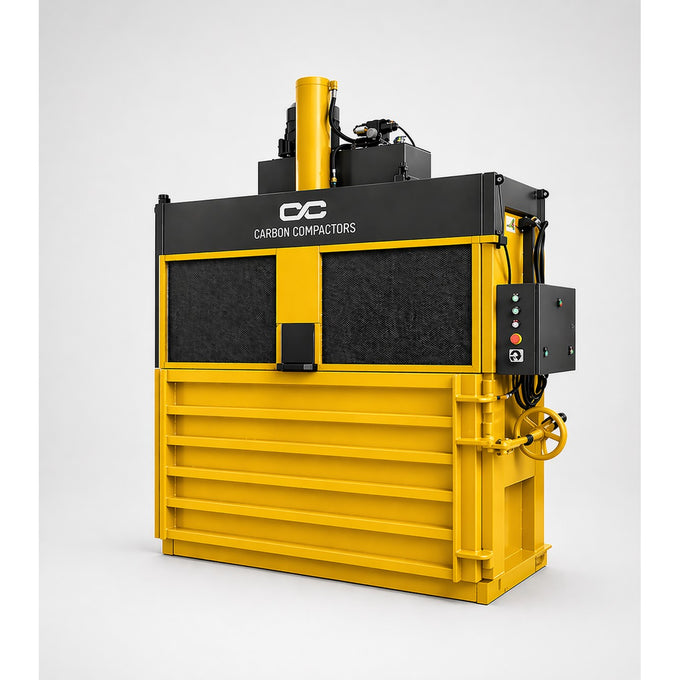
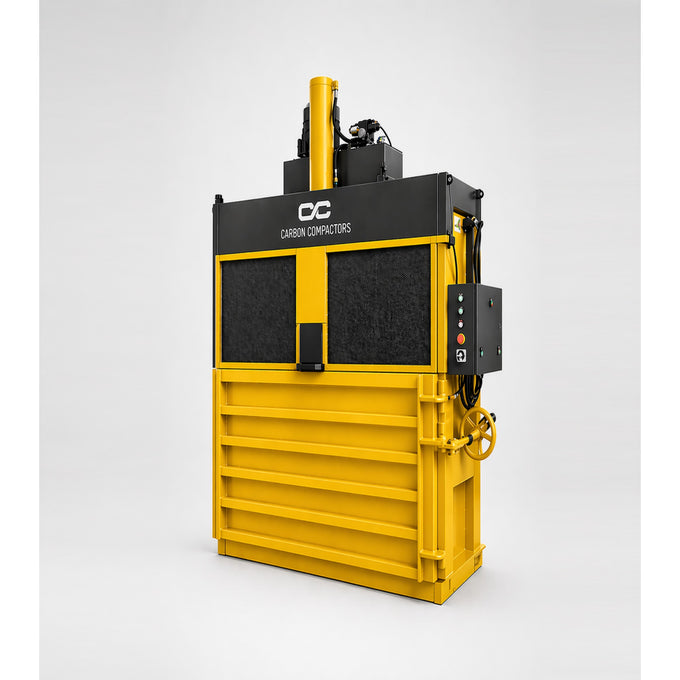
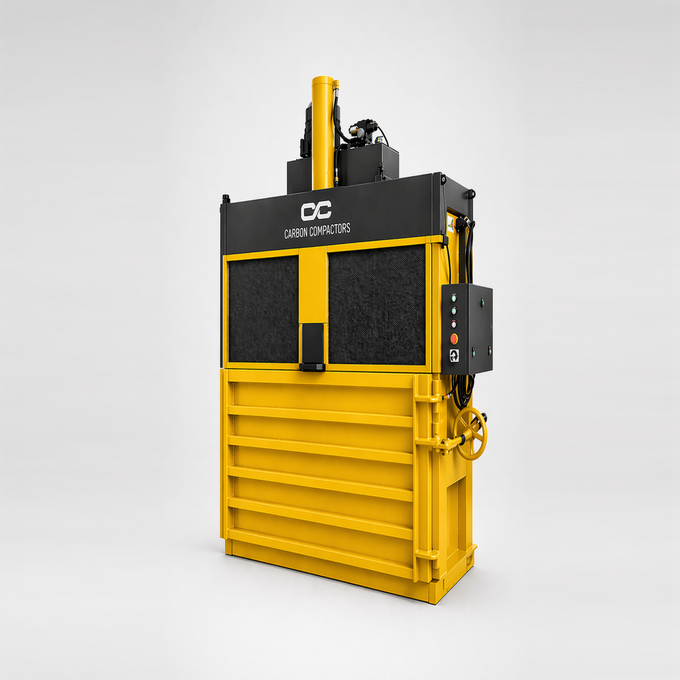
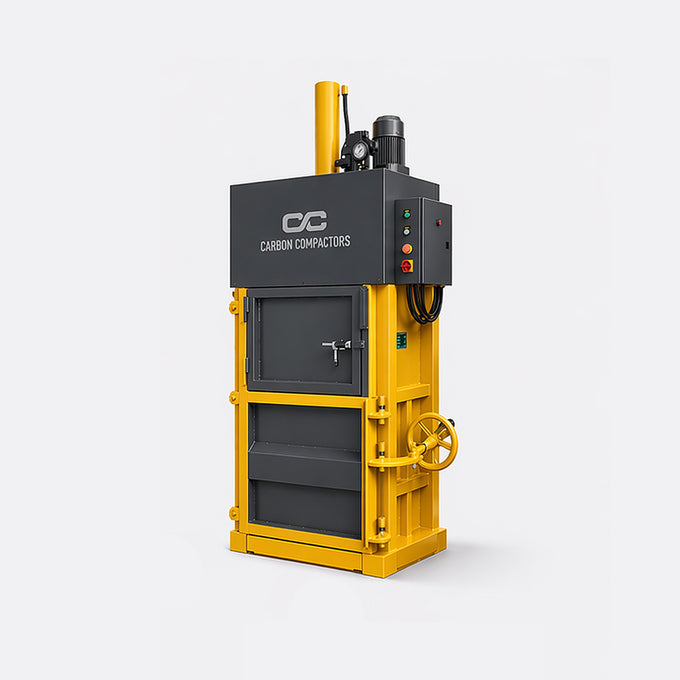
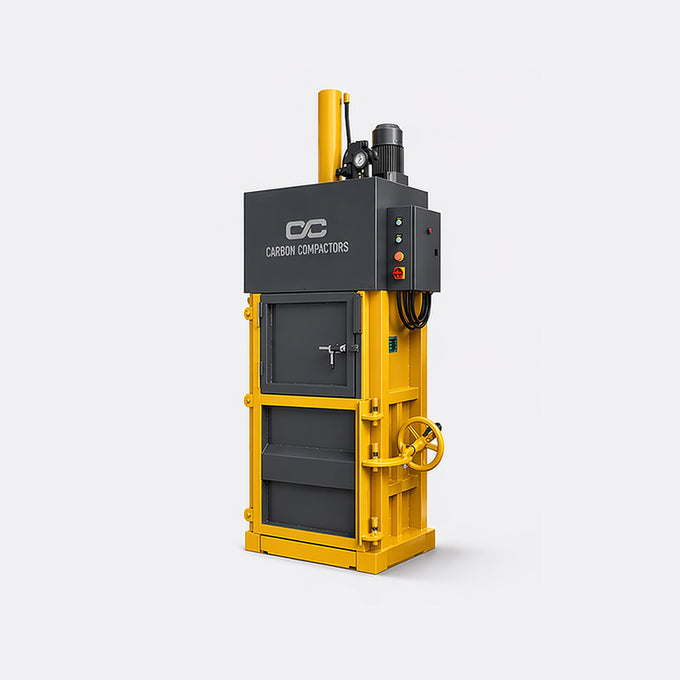
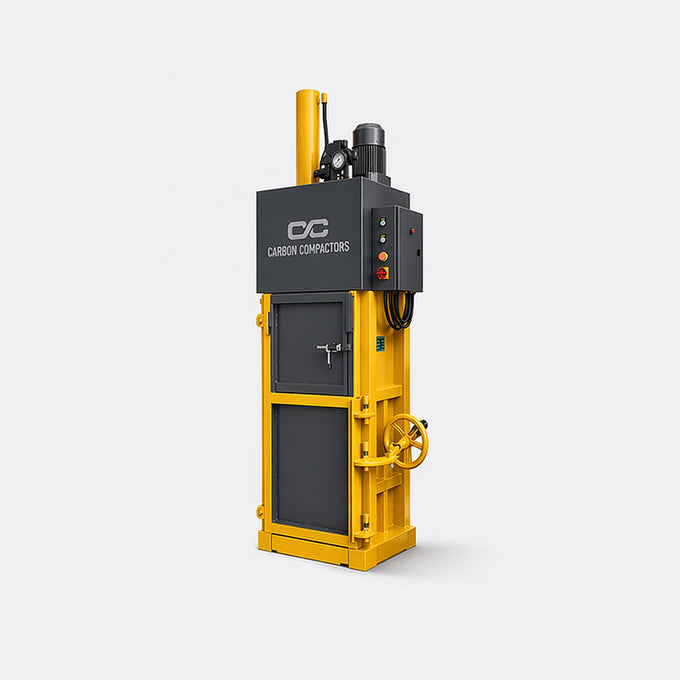
A commercial cardboard compactor — more precisely called a vertical cardboard baler — uses hydraulic force to compress loose cardboard boxes into dense, wire-tied bales. These machines cost between $6,995 and $18,750, install in under two hours, and typically cut waste hauling bills by 60 to 80 percent. If you generate more than 10 cardboard boxes per day, a compactor pays for itself in months, not years.
What Is a Cardboard Compactor?
A cardboard compactor is a machine that reduces the volume of corrugated cardboard, shipping boxes, and paper packaging by compressing it under hydraulic pressure. The term is used interchangeably with "cardboard baler" by most business owners — and the confusion is understandable, because both machines do the same job: take a pile of loose cardboard and turn it into something small, dense, and manageable.
In commercial settings, you will encounter two different types of machines that go by this name:
- Vertical cardboard balers — The machine most businesses actually need. Compresses cardboard into portable bales tied with wire. The bales can be sold to a recycler for cash, which means hauling costs go down and you may also earn revenue. These machines cost $6,995 to $18,750 and install indoors with minimal space requirements.
- Container compactors — Large outdoor machines, often chute-fed or self-contained, that crush mixed waste into a sealed container a hauler removes. These are designed for wet, mixed waste — not dry cardboard recycling. They are more expensive to operate, generate no recycling revenue, and are the wrong tool for pure cardboard streams.
If you are searching for a machine to handle the cardboard from product deliveries, shipments, or packaging — the answer is a vertical cardboard baler. Our cardboard compactors for sale range from $6,995 to $18,750 depending on tonnage and volume capacity. Browse our full lineup of vertical cardboard balers starting at $6,995 or keep reading to find the right size for your operation.
Cardboard Compactor vs. Cardboard Baler: Are They the Same Thing?
In commercial practice, yes — "cardboard compactor" and "cardboard baler" refer to the same machine. Both terms describe a vertical hydraulic press that compresses dry cardboard into portable bales. The difference is terminology, not product.
The word "compactor" stuck because it accurately describes what the machine does: it compacts. "Baler" is the more precise industry term, because the machine also ties the compressed material into a bale ready for recycling pickup. When manufacturers, haulers, and recycling coordinators say "baler," they mean the same machine a restaurant owner calls a "compactor."
Where the distinction matters is when comparing a cardboard baler to a true commercial compactor — the large, self-contained outdoor unit used for mixed waste or food waste. These are entirely different machines:
| Feature | Vertical Cardboard Baler (what you want) | Commercial Container Compactor (probably not) |
|---|---|---|
| Output | Wire-tied bales you can sell to recyclers | Compressed waste in a sealed container; hauler removes it |
| Revenue potential | Yes — OCC cardboard bales sell for $50 to $200+ per ton | No — you still pay per haul |
| Purchase price | $6,995 to $18,750 | $8,000 to $40,000+, plus installation |
| Ongoing hauling cost | Greatly reduced or eliminated (recycler picks up bales) | Reduced frequency, but you still pay per haul |
| Best material | Dry cardboard, paper, plastic film — clean, separated streams | Mixed waste, food waste, general commercial trash |
| Installation | Indoor, 15 to 40 sq ft, no truck clearance needed | Outdoor or dock-adjacent, large footprint, truck access required |
| Power | Small units: 120V single-phase (standard outlet). Larger: 208/230V or 480V 3-phase | 208/230V or 480V 3-phase required |
For a complete breakdown of the two machine categories — including when a true compactor actually makes sense — read our dedicated article: Cardboard Baler vs. Compactor: Which Does Your Business Need?
How a Cardboard Compactor Works
A vertical cardboard compactor operates through a straightforward four-stage cycle that any employee can learn in about 15 minutes.
Load. Open the front loading door and load flattened cardboard boxes into the compression chamber. Safety interlocks on every Carbon Compactors machine prevent the ram from activating while the door is open.
Compress. Close the door and press the cycle button on the control panel. A hydraulic ram descends through the chamber, compressing the cardboard under 5 to 60 tons of force — depending on the model. Each compression cycle runs 30 to 60 seconds. Repeat the load-and-compress cycle until the chamber is full.
Tie. When the bale-full indicator light signals the chamber is packed, thread baling wire through the built-in wire channels and tie off the bale. This takes about three minutes for most operators.
Eject. Open the ejection door and push or pull the finished bale out. A Carbon 24-VB baler produces bales in the 35 to 90 lb range, movable by one person with a hand truck. A Carbon 72-VB produces bales up to 1,550 lbs, requiring forklift handling. Stack bales in a dry area and call your recycler when you have a full load.
The machines use industrial hydraulic systems with Schneider Electric controls on our larger LE-series models. No compressed air line, no complex plumbing — just electrical power and a hydraulic fluid reservoir that needs checking twice a year.
Benefits of Using a Cardboard Compactor
The primary reason businesses buy a cardboard compactor is cost savings. Everything else — floor space, worker time, sustainability — is a real benefit, but the ROI story is what justifies the purchase order.
Reduced Waste Hauling Costs
Most businesses without a baler pay a waste hauler $150 to $400 per pickup, two to five times per week. A baler collapses cardboard to roughly one-tenth of its original volume. That means 10 pickups' worth of material fits in one pickup's container — which means your hauling frequency and monthly bill drop by 60 to 80 percent. Some businesses cut their cardboard hauling bill to zero: recyclers pick up bales at no charge (or even pay you for the material).
Recycling Revenue
OCC (old corrugated cardboard) is a commodity with real market value. Bale prices fluctuate, but OCC typically trades at $50 to $200 per ton. A business producing two bales per week — a typical retail store with a Carbon 24-VBHD — generates roughly $100 to $400 per month in recycling revenue at current market rates. That is a bonus on top of the hauling cost reduction.
Reclaimed Floor Space
A loaded cardboard dumpster or compactor room takes up valuable real estate. A Carbon 24-VB cardboard baler occupies 34" W x 40" D of floor space — about the footprint of a standard office desk. The machine stands 74 inches tall and does not require truck clearance, outdoor placement, or a dedicated room. A door-adjacent corner in the back of the house is sufficient for most installations.
Worker Safety and Efficiency
Loose cardboard creates trip hazards, blocks emergency exits, and turns break rooms and loading docks into obstacle courses. A baler eliminates the cardboard pile problem entirely. Instead of staff making repeated trips to an overflowing dumpster, one person runs the baler as part of their normal shift duties — typically 10 to 20 minutes per day for a small retail operation, longer for high-volume facilities.
Sustainability Compliance
An increasing number of municipalities, retail standards bodies, and corporate sustainability frameworks require documented cardboard diversion from landfill. A baler with recycler pickups provides the paper trail. Some franchise agreements now require baler use at locations above a certain cardboard-generation threshold.
How Much Does a Cardboard Compactor Save? ROI Breakdown
The most common question we get is not "how does it work" — it is "when does it pay for itself." The answer depends on your current hauling costs and cardboard volume, but here are three realistic scenarios based on typical business profiles.
Scenario 1: Small Retail Store or Restaurant (Low Volume)
Situation: 10 to 30 boxes per day, two hauler pickups per week at $200 per pull.
- Current annual hauling cost: $20,800
- Baler reduces hauling to one pickup per month: $2,400/year
- Annual savings on hauling: $18,400
- Recycling revenue (estimated): $1,200 to $2,400/year
- Total annual benefit: $19,600 to $20,800
- Carbon 24-VB baler cost: $6,995
- Payback period: Under 5 months
Scenario 2: Mid-Size Grocery or Distribution Operation (Medium Volume)
Situation: 100 to 300 boxes per day, five hauler pickups per week at $275 per pull.
- Current annual hauling cost: $71,500
- Baler eliminates paid hauling — recycler now picks up at no cost: $0
- Annual savings on hauling: $71,500
- Recycling revenue (estimated): $6,000 to $12,000/year
- Total annual benefit: $77,500 to $83,500
- Carbon 32-VB baler cost: $10,495
- Payback period: Under 2 months
Scenario 3: Large Warehouse or Multi-Shift Fulfillment Center (High Volume)
Situation: 500+ boxes per day, daily hauler pickups at $350 per pull, multi-shift operation.
- Current annual hauling cost: $127,750
- Baler eliminates paid hauling — recycler pays for material pickup: $0
- Annual savings on hauling: $127,750
- Recycling revenue (estimated): $18,000 to $36,000/year
- Total annual benefit: $145,750 to $163,750
- Carbon 43-VB or Carbon 48-VB baler cost: $14,995 to $15,995
- Payback period: Under 5 weeks
These numbers use conservative hauling cost estimates. In high-cost urban markets — New York, Los Angeles, Chicago — commercial hauling runs significantly higher, shortening the payback period further. Use our baler ROI calculator to plug in your actual hauling costs and get a personalized estimate.
What Size Cardboard Compactor Do You Need?
Size selection comes down to two variables: how much cardboard you generate daily, and your power supply. Here is how our seven models map to real business types.
| Model | Press Force | Bale Weight | Power | Price | Best For |
|---|---|---|---|---|---|
| Carbon 24-VB | 5 tons | 35–90 lbs | 120V single-phase | $6,995 | Restaurants, coffee shops, small retail — up to 30 boxes/day |
| Carbon 24-VBHD | 10 tons | 45–110 lbs | 120V single-phase | $7,995 | Larger retail stores, franchise locations — 30 to 80 boxes/day |
| Carbon 32-VB | 20 tons | 130–265 lbs | 208/230V or 480V 3-phase | $10,495 | Grocery stores, mid-size distribution — 80 to 200 boxes/day |
| Carbon 43-VB | 30 tons | Up to 550 lbs | 208/230V or 480V 3-phase | $14,995 | Warehouses, large distribution centers — 200 to 400 boxes/day |
| Carbon 48-VB | 40 tons | Up to 1,000 lbs | 208/230V or 480V 3-phase | $15,995 | Multi-shift warehouses and manufacturing — 400 to 700 boxes/day |
| Carbon 60-VB | 50 tons | Up to 1,100 lbs | 208/230V or 480V 3-phase | $16,995 | High-volume fulfillment and 3PL operations — 700+ boxes/day |
| Carbon 72-VB | 60 tons | Up to 1,550 lbs | 208/230V or 480V 3-phase | $18,750 | Recycling centers, MRFs, heavy commercial — continuous high-volume |
The 120V Advantage for Smaller Operations
The Carbon 24-VB and Carbon 24-VBHD plug into a standard 120V single-phase outlet — the same outlet your coffee machine uses. No electrician, no panel upgrade, no three-phase power required. For a restaurant, café, or small retail store, this eliminates the #1 installation barrier. Bring the machine in, plug it in, and you are baling the same day it arrives.
The Carbon 32-VB through Carbon 72-VB require 208/230V or 480V three-phase power, which is standard in most commercial buildings with loading docks or warehouse space. If you are not sure which power you have, your building's electrical panel will tell you — or ask your facilities manager.
For a more detailed walkthrough of how to match volume to machine, visit our cardboard baler sizing guide. It covers daily box count estimates by industry, chamber dimensions, and what to do if you are between two size tiers.
Industries We Serve
Grocery and Supermarket
Grocery stores are among the highest-volume cardboard generators in retail — daily produce deliveries, packaged goods, dry goods, and seasonal stock all arrive in corrugated boxes. A mid-size grocery store processing 150 to 300 boxes per day typically outgrows a Carbon 24-VBHD quickly. The Carbon 32-VB at $10,495 is the standard starting point, producing bales in the 130 to 265 lb range that most regional recyclers accept. For large-format stores or regional distribution hubs, the Carbon 43-VB or Carbon 48-VB handles multi-department cardboard streams without bottlenecks.
Distribution and Fulfillment
Distribution centers and 3PL warehouses generate cardboard at a rate that makes manual disposal economically indefensible. A facility processing 500 inbound and outbound shipments per day can produce more than 1,000 lbs of corrugated per shift. At that volume, the question is not whether to buy a baler — it is which one. The Carbon 43-VB handles up to 551-lb bales and suits single-shift operations; the Carbon 48-VB and Carbon 60-VB support multi-shift facilities where the baler runs most of the day.
Manufacturing
Manufacturing facilities deal with two cardboard streams: inbound packaging from raw materials and components, and outbound packaging for finished goods. The volumes are predictable, making ROI calculation straightforward. Most manufacturing plants already have three-phase power, so installation of the Carbon 32-VB through Carbon 72-VB models is typically plug-and-play. Facilities generating corrugated plus plastic film benefit from balers that handle both materials — all Carbon Compactors models process cardboard, kraft paper, and plastic film in the same chamber.
Hospitality — Hotels and Resorts
Hotels receive daily amenity deliveries, linen shipments, food and beverage stock, and event supplies — all in corrugated boxes. Most mid-size hotels generate 30 to 100 boxes per day across departments. The Carbon 24-VB or Carbon 24-VBHD works for a 100 to 200 room property; larger resorts or properties with significant food and beverage programs typically step up to the Carbon 32-VB. The 120V plug-in option on the Carbon 24-VB and Carbon 24-VBHD is especially attractive for properties without easy access to three-phase power near the loading dock.
Franchise Operations
Franchise operators run lean. A QSR franchise producing 20 to 40 boxes of cardboard per day is paying a hauler $150 to $300 per pickup, often twice a week. That is $15,600 to $31,200 per year in hauling costs per location — before adding recycling fees or surcharges. The Carbon 24-VB at $6,995 eliminates the bulk of that expense and pays for itself in three to five months at typical franchise volumes. Multi-location operators can standardize on one model across all sites, simplifying maintenance and operator training. Our complete buying guide covers multi-location purchasing considerations in detail.
Retail — Specialty and Big-Box
Retail cardboard volume correlates directly with inventory turnover. A specialty retailer with 30 to 50 deliveries per week may process 50 to 100 boxes of corrugated daily. A big-box retailer or membership warehouse club processes far more — often 500 to 1,000 boxes per day across departments. The right baler size scales with the operation: Carbon 24-VBHD for mid-size specialty retail, Carbon 32-VB or Carbon 43-VB for larger format stores and category retailers.
Frequently Asked Questions About Cardboard Compactors
What is a cardboard compactor and how does it work?
A cardboard compactor is a hydraulic machine that compresses loose cardboard boxes and corrugated packaging into compact, wire-tied bales. An operator loads cardboard into the chamber, presses a cycle button, and the hydraulic ram descends to compress the material. Each cycle takes 30 to 60 seconds. Once the chamber is full, the operator ties the bale with wire and ejects it. The resulting bale is dense enough to stack, store, and sell to a recycling facility. For a detailed step-by-step walkthrough, see What Is a Cardboard Baler? How It Works, Types & Costs.
Is a cardboard compactor the same as a cardboard baler?
Yes, in commercial practice. Both terms refer to the same machine: a vertical hydraulic press that compresses dry cardboard into portable bales. "Baler" is the industry-standard term; "compactor" is the word most non-specialist buyers use when searching for the equipment. The only time the distinction matters is when comparing a cardboard baler to a true commercial compactor — the large outdoor unit used for mixed wet waste. If you are managing a cardboard recycling stream, a vertical baler is the right machine. See the full comparison article for specifics.
What size cardboard compactor does my business need?
Start with your daily box count. Under 30 boxes per day: the Carbon 24-VB ($6,995, 120V) is sufficient. 30 to 80 boxes per day: the Carbon 24-VBHD ($7,995, 120V). 80 to 200 boxes: Carbon 32-VB ($10,495, 3-phase). Above 200 boxes per day, you are looking at the Carbon 43-VB through Carbon 72-VB range. If your count falls in the gray zone, size up — a machine that is slightly oversized for today handles growth without requiring replacement in 18 months. Use our sizing guide to run the calculation with your specific numbers.
How much can I save on waste hauling costs?
Most businesses reduce waste hauling costs by 60 to 80 percent after installing a vertical cardboard baler. A small retail store paying $400 per week in hauling ($20,800/year) typically cuts that to under $2,500 per year — and may earn $1,200 to $2,400 more in recycling revenue. The Carbon 24-VB at $6,995 pays for itself in under five months at those numbers. Higher-volume operations see even faster payback: a distribution center saving $127,000/year in hauling recovers a $15,000 machine investment in under six weeks. Use the ROI calculator to run your own numbers.
Can I finance or lease a cardboard compactor?
Financing is available through third-party equipment lenders. Most vertical balers in the $6,995 to $18,750 range qualify for standard equipment financing with terms from 24 to 60 months. At 60-month terms, a Carbon 24-VB runs roughly $125 to $155 per month — often less than a single week's hauling bill. Leasing is also an option through select lenders. Contact us for current financing options and to discuss what works for your budget.
How long does a cardboard compactor last?
A well-maintained vertical cardboard baler runs for 15 to 20 years in regular commercial use. The hydraulic system — the core of the machine — is the critical component; checking fluid levels twice a year and replacing hydraulic fluid every three to five years keeps it running. All Carbon Compactors machines come with a 5-year warranty — significantly longer than the 1-year standard offered by most competitors. The structural frame and cylinder bore are built for industrial duty cycles, not light commercial use.
What maintenance does a cardboard compactor require?
Day-to-day maintenance is minimal. After each shift, clear any cardboard debris from around the machine and inspect the safety gate operation. Monthly: check hydraulic fluid level, inspect the baling wire supply, and verify all indicator lights are functioning. Annually: inspect hydraulic hoses and cylinder seals for wear, lubricate moving parts per the operator's manual, and test all safety interlocks. A full annual service takes about two hours and requires no specialized equipment — a wrench set, rags, and a hydraulic fluid refill are sufficient. Total annual maintenance cost runs $300 to $600 for parts and consumables.
How long does shipping take, and how is the machine delivered?
All Carbon Compactors machines ship within 8 to 10 weeks of order. Delivery is freight — the machine ships on a pallet via LTL carrier. Every order includes free freight shipping nationwide, with liftgate delivery to your dock or curb. The Carbon 24-VB and Carbon 24-VBHD weigh under 1,000 lbs and can be moved with a pallet jack. Larger models require a forklift for final positioning. See our shipping and delivery page for detailed logistics information, including what to check on delivery and how to handle freight damage.
Why Buy From Carbon Compactors?
We sell seven commercial cardboard compactors — and nothing else. That focus lets us go deep on product knowledge, support, and service in a way a general industrial equipment dealer cannot.
- Transparent pricing. Every price is on the page: $6,995 to $18,750. No quote forms, no "call for pricing." Four out of five competitors in this market hide prices. We do not.
- 5-year warranty, standard. Most manufacturers offer one year. Our 5-year warranty covers the hydraulic system, structural components, and electrical controls. It is included with every machine at no additional cost.
- Free freight shipping, nationwide. Every order ships freight, fully prepaid, with liftgate delivery. No surprise freight charges at checkout.
- 8 to 10 week lead time. Most industrial baler competitors quote 10 to 16 weeks. We deliver faster because our supply chain is purpose-built for this product line.
- Six color options, no upcharge. Choose from six standard colors to match your facility. Included at no extra cost.
- US-based support. Questions before or after purchase reach a real person who knows these machines. We are not a dropshipper routing you to a manufacturer's overseas support desk.
Ready to see which machine fits your operation? Browse all seven models with full specifications, or view our flagship Carbon 72-VB if you are running a high-volume commercial operation. If you are still working through the decision, our complete buying guide walks through every consideration from power requirements to recycler relationships.